Wednesday, 8 October 2014

Pregnant With Twins With Husband Albert II-US Weekly


Princess Charlene of Monaco Pregnant With Twins With Husband Albert II
.

Princess Charlene of Monaco Pregnant With Twins With Husband Albert II
Double royal trouble! Princess Charlene of Monaco is pregnant with twins, a source confirms to Us Weekly.

The mom-to-be and her husband Prince Albert II announced in May that they were first expecting. "The birth is expected at the end of the year," the couple told Us in a statement at the time.

Princess Charlene, 36, and 56-year-old Albert II — the son of Rainier III, Prince of Monaco and the late legend Grace Kelly — first met in 2000 during a swimming competition. The royal couple later tied the knot in Monaco in July 2011.

Albert II discussed his wife's pregnancy at the opening of the new Monaco Yacht Club in June. "[We're] taking every cautious step to make sure everything goes well," he said, via Daily Mail. He added to the Associated Press that the pair were "overjoyed" and "thrilled" about the next chapter.

The twins will be the first children for Princess Charlene (maiden name: Wittstock). She showed off her growing baby bump at the Seventh Annual World Focus on Autism event in NYC on Sept. 25. Albert II is already dad to Jazmin Grace Grimaldi, 22, and Alexandre Coste, 10, whom he had in previous relationships.

Culled from us weekly in yahoo celebrity

Angelina Jolie Still Feels Mom's Influence, Raises Her Kids in Her Style-US Weekly


Angelina Jolie Still Feels Mom's Influence, Raises Her Kids in Her Style

Angelina and mom
Angelina Jolie's mom Marcheline Bertrand died seven years ago, but the actress still feels her influence whenever she looks at her children.

The Maleficent actress told French Marie Claire magazine that much of her life — from how she parents her children to her philanthropy — is down to her late-mom's influence.
"I feel in contact with my mother when I look at my children," the 39-year-old mom-of-six told the publication. "I can feel her influence over me then."

"I see that my way of raising them resembles the way she raised my brother and I. It's more apparent with my daughters Shiloh and Vivienne. My mother is there, present in this influence, all the time."
Jolie, who married long-time partner Brad Pitt in August, made sure her beloved mother was remembered on that day by wearing a ring that had belonged to her.
But Bertrand's influence is all pervasive in Jolie's everyday life, especially when it comes to her passion for charity, and her role as an ambassador for the UNHCR.

Jolie talked to the magazine about how her mom always encouraged her to get involved in aid work. "She always tried to understand the complexity of the world," Jolie continued. "She had a great heart, which was sensitive to the world's violence."
"She was very soft but could move mountains for her kids," the actress added. "That's something I always admire in women: that mix of softness and strength."
Jolie's mother died in 2007 after losing her battle against cancer. The actress herself has undergone a preventative mastectomy to protect herself from the disease and has spoken about plans to have her ovaries removed in the future.

Source US weekly in Yahoo Celebrity

Tuesday, 7 October 2014

Cost of Living in the 7 Most Beautiful Cities in the World-Erika Rawes

Have you ever thought about moving to another country? By the age of 44, the average American has only moved around 3 times in his or her lifetime. When most people move, they stay close by and that’s why we often see people moving to a few different places within the same city.

According to the Census Bureau, about 36.5 million people — or about 12 percent of the population — moved in the year 2012. However, almost 65 percent of these movers stayed within the same small area — their home county. Even those who moved to a different zip code still stayed pretty close by. Of those who relocated to a different county, upwards of 40 percent of them stayed within 50 miles of their previous location.
There are a handful of people, however, who enjoy traveling, experiencing different places, and are willing (or should we say able) to up and move to a new city, no matter how far away it may be. Even if we are unable to actually move to a city on the other side of the world, thinking about the possibility can be an experience in itself.
Using publications by Fabulous Traveling and U City Guides, coupled with traveler reviews and a bit of personal experience, we ranked some of the most beautiful cities in the world. Then, we used cost of living data (all pricing data comes from Expatistan.com) to calculate how much of a salary someone would need to live in each of these cities. Which ones can you afford to live in?
Bas Czerwinski/AFP/Getty Images

7. Amsterdam

  • Cost of a fast-food combo meal: $9
  • Dinner for two at a neighborhood pub: $54
  • Cost of a 2-liter of cola: $2.77
  • A dozen eggs: $3.43
  • Monthly rent for a furnished home in an upscale area: $2,453
  • Utilities for 2 people in a small place: Around $210
  • 1 liter (1/4 gallon) of gas: $2.34
  • 40-inch flat screen TV: $682
  • A new car (Volkswagen Golf 2.0 TDI or similar):  $37,950
  • Two tickets to the movies: $28
  • Estimated salary (household income) needed to live here comfortably: $70,000 to $100,000 per year 
Source: Thinkstock
Source: Thinkstock

6. Lisbon

  • Cost of a fast-food combo meal: $7
  • Dinner for two at a neighborhood pub: $40
  • Cost of a 2-liter of cola: $2.22
  • A dozen eggs: $2.73
  • Monthly rent for a furnished home in an upscale area: $1,359
  • Utilities for 2 people in a small place: Around $134
  • 1 liter (1/4 gallon) of gas: $2.12
  • 40-inch flat screen TV: $490
  • A new car (Volkswagen Golf 2.0 TDI or similar):  $37,738
  • Two tickets to the movies: $16
  • Estimated salary (household income) needed to live here comfortably: $40,000 to $70,000 per year
Attila Kisbenedek/AFP/Getty Images

5. Budapest 

  • Cost of a fast-food combo meal: $5.90
  • Dinner for two at a neighborhood pub: $27
  • Cost of a 2-liter of cola: $1.75
  • A dozen eggs: $2.13
  • Monthly rent for a furnished home in an upscale area: $670
  • Utilities for 2 people in a small place: Around $230
  • 1 liter (1/4 gallon) of gas: $1.79
  • 40-inch flat screen TV: $5.91
  • A new car (Volkswagen Golf 2.0 TDI or similar):  $28,343
  • Two tickets to the movies: $14
  • Estimated salary (household income) needed to live here comfortably: $27,000 to $47,000
Yasuyoshi Chiba/AFP/Getty Images

4. Rio De Janeiro

  • Cost of a fast-food combo meal: $9
  • Dinner for two at a neighborhood pub: $36
  • Cost of a 2-liter of cola: $2.08
  • A dozen eggs: $1.94
  • Monthly rent for a furnished home in an upscale area: $2,413
  • Utilities for 2 people in a small place: Around $151
  • 1 liter (1/4 gallon) of gas: $1.34
  • 40-inch flat screen TV: $811
  • A new car (Volkswagen Golf 2.0 TDI or similar):  $23,611
  • Two tickets to the movies: $19
  • Estimated salary (household income) needed to live here comfortably: $65,000 to $95,000 per year
Source: Thinkstock
Source: Thinkstock

3. Paris

  • Cost of a fast-food combo meal: $10
  • Dinner for two at a neighborhood pub: $51
  • Cost of a 2-liter of cola: $3.17
  • A dozen eggs: $4.68
  • Monthly rent for a furnished home in an upscale area: $3,617
  • Utilities for 2 people in a small place: Around $167
  • 1 liter (1/4 gallon) of gas: $2.08
  • 40-inch flat screen TV: $594
  • A new car (Volkswagen Golf 2.0 TDI or similar):  $32,398
  • Two tickets to the movies: $26
  • Estimated salary (household income) needed to live here comfortably: $80,000 to $150,000 per year
Sean Gallup/Getty Images

2. Prague

  • Cost of a fast-food combo meal: $6
  • Dinner for two at a neighborhood pub: $19
  • Cost of a 2-liter of cola: $1.73
  • A dozen eggs: $2.22
  • Monthly rent for a furnished home in an upscale area: $1,020
  • Utilities for 2 people in a small place: Around $179
  • 1 liter (1/4 gallon) of gas: $1.75
  • 40-inch flat screen TV: $590
  • A new car (Volkswagen Golf 2.0 TDI or similar):  $22,189
  • Two tickets to the movies: $15
  • Estimated salary (household income) needed to live here comfortably: $40,000 to $60,000 per year
Marco Secchi/Getty Images

1. Venice

  • Cost of a fast-food combo meal: $9
  • Dinner for two at a neighborhood pub: $41
  • Cost of a 2-liter of cola: $2.68
  • A dozen eggs: $2.50 to $4.04
  • Monthly rent for a furnished home in an upscale area: $1,670
  • Utilities for 2 people in a small place: Around $358
  • 1 liter (1/4 gallon) of gas: $2.34
  • 40-inch flat screen TV: $749
  • A new car (Volkswagen Golf 2.0 TDI or similar):  $28,729
  • Two tickets to the movies: $22
  • Estimated salary (household income) needed to live here comfortably: $50,000 to $75,000 per year
Culled from wallstreetcheatsheet

Nigeria talks tough, warns South Africa over seized $5.7 million arms money


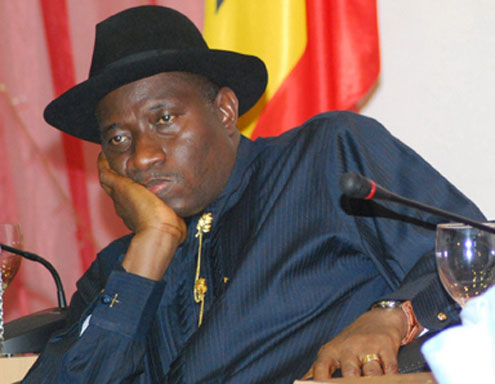
President Goodluck Jonathan
Nigeria responded with fury Monday after South African authorities confiscated a second tranche of funds meant for arms purchase to fight the extremist Boko Haram sect, denying the deal was unlawful and warning South Africa of its investment in Nigeria.
The warning came after the South African government seized US$5.7 million wired by the Nigerian government through a bank to an arms dealer in that country.
South Africa’s Asset Forfeiture Unit of the National Prosecuting Authority said the money, about N952 million, was the proceed of illegal transactions, according to local paper, City Press.
The seizure was the second in nearly three weeks, coming after authorities there froze $9.3 million transported in cash by two Nigerians and an Israeli for arms purchase. At the time, South Africa said the transaction violated its laws on movement of cash.
In a terse reaction to what appears a potential diplomatic spat between the two countries, the Nigerian government denied the second transaction was illegal and reminded South Africa of how Nigeria has provided a beneficial environment for South African companies like MTN, DSTV and a host of others to do business unhindered.
“It is our hope that South Africa would reciprocate this noble gesture,” the National Security Adviser, Sambo Dasuki, said Monday, with a vow to eradicate Boko Haram regardless of the antics of “fifth columnists”.
Mr. Dasuki, named by the South African newspaper as the official who signed off the first controversial deal, confirmed late Monday the second transaction occurred as reported but firmly denied it was conducted illegally.
“We want to state clearly that a business transaction actually took place between a legitimate company in Nigeria and another legitimate one in South Africa through the bank,” said Mr. Dasuki through a spokesperson, Karounwi Adekunle.
“In the course of events, the South African company could not perform and decided to refund the money. What is illegitimate in this transaction done through the bank?” he queried.
Details of the latest transaction came more than two weeks after two Nigerians and an Israeli were arrested as they attempted to smuggle US$9.3 million through Lanseria International Airport, Johannesburg, on September 5 in a private jet from Abuja.
The money, stashed in three suitcases, raised suspicion when the passengers’ luggage were unloaded and put through the scanners.
The National Prosecuting Authority, NPA, in South Africa said there was an invoice for helicopters and armaments intended to be used in Nigeria.
Two black plastic suitcases, filled with 90 blocks each containing US$100,000 in notes, with combination locks, were seized, as well as two pieces of hand luggage also containing US currency, according to City Press.
The Israeli national, Eyal Mesika, had the combination to open the locks.
Under South African laws, a person entering or leaving the country is expected to carry cash not exceeding US$2,300, or the equivalent in foreign currency notes.
The news of the first transaction angered Nigerians, particularly as it became clear the private jet involved belonged to the head of the Christian Association of Nigeria, CAN, Ayo Ortisejafor.
Mr. Oritsejafor, a close ally of President Goodluck Jonathan, said the plane had been leased to a third party and he could not be blamed for its schedules.
The Nigerian government later admitted it was behind the arms deal, claiming it acted out of desperation for arms to defeat extremist sect, Boko Haram.
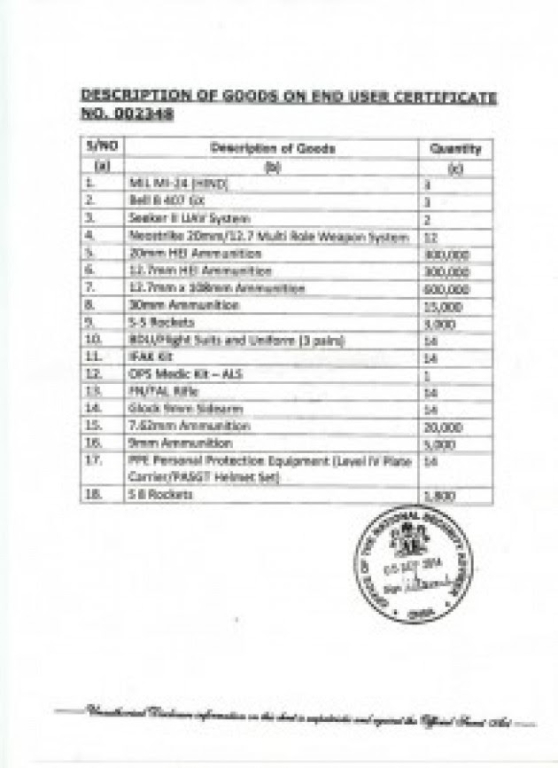
South African paper, City Press, said it was the NSA, Mr. Dasuki, who personally authorised the first arms contract by issuing an end-user certificate, alongside a “shopping list” for helicopters, unmanned aircraft, rockets and ammunition.
But Nigerian security officials said the report by the newspaper indeed provided proof that the first transaction was not illegitimate as well, since the end-user certificate and a shopping list were provided.
A security source was quoted as saying “in issuing end-user certificate, the ONSA (Office of the National Security Adviser) ensures that it carries all relevant agencies and stakeholders along. Therefore, such a responsibility is not a unilateral development,”  according to PRNigeria, an agency frequently used by the Nigerian military to disseminate official statements.
“For security reasons, the chains leading to the issuance of end-user certificate cannot be put in the public domain.
“The recent interest in arms purchase was informed by the challenges of insurgency which our nation had been grappling with in the last few years. This is why the understanding of all Nigerians is necessary.
“Nigeria is desperate to counter activities of terrorists no matter what it takes even when some of our friends are not being fair to us,” the agency said Monday.
The latest transaction was between Cerberus Risk Solutions, an arms broker in Cape Town, and Societe D’Equipments Internationaux, said to be a Nigerian company based in Abuja.
The paper said the deal fell apart after Cerberus, which had earlier received from Nigeria R60 million (N1.02 billion) through its account at Standard Bank, tried to repay the money as it could not resolve its registration formalities with the South African authorities.
“Cerberus was previously registered as a broker with the National Conventional Arms Control Committee (NCACC), but the registration expired in May this year,” City Press said.
“The marketing and contracting permits also expired at the same time. The company has since applied for re-registration, but the application lay in the NCACC’s mailbox for more than two months.
“Sources told Rapport that Cerberus apparently tried to pay the money back to the Nigerian company, after which the bank became suspicious,” the paper reported.
The paper added that while the NPA’s Asset Forfeiture Unit subsequently obtained a court order in the South Gauteng High Court to seize the money, the NPA spokesperson Nathi Mncube, said there were no indications the two transactions were related.
“However, both are now the subject of a criminal investigation and all possible information and connections are being investigated,” Mr. Mncube was quoted as saying.
The statement from Mr. Dasuki’s office confirmed the inability of the South African company to deliver and the attempt to refund

Source Premium Times

South Africa busts another secret Nigeria arms deal, seizes $5.7 million


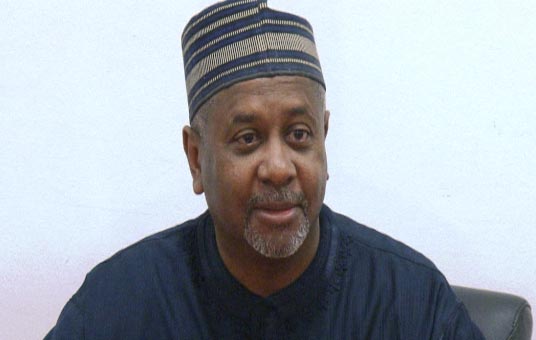
National Security Adviser - Sambo Dasuki
South African authorities have confiscated yet another US$5.7 million arms money from Nigeria, nearly three weeks after seizing $9.3 million in cash transported by two Nigerians and an Israeli for arms purchase, South Africa-based City Express reported Monday.
As with the first deal, South Africa’s Asset Forfeiture Unit of the National Prosecuting Authority seized the $5.7 million (about N952 million) for allegedly being the proceeds of illegal transactions, the paper said.
The news came more than two weeks after two Nigerians and an Israeli national were arrested in South Africa after they attempted to smuggle US$9.3 million apparently meant for buying arms for the Nigerian intelligence service.
The men landed at Lanseria International Airport, Johannesburg, on September 5 in a private jet from Abuja with the money stashed in three suitcases.
At the time, the South Africa Revenue Service, SARS, said customs officers became suspicious when the passengers’ luggage were unloaded and put through the scanners.
The National Prosecuting Authority, NPA, in South Africa said there was an invoice for helicopters and armaments intended to be used in Nigeria.
Nigeria-SA-Money-Laundering-2Two black plastic suitcases, filled with 90 blocks each containing US$100,000 in notes, with combination locks, were seized, as well as two pieces of hand luggage also containing US currency, according to City Press.
The Israeli national, Eyal Mesika, had the combination to open the locks.
Under South African laws, a person entering or leaving the country is expected to carry cash not exceeding US$2,300, or the equivalent in foreign currency notes.
The news of the first transaction sparked anger in Nigeria after it emerged the private jet involved belonged to the head of the Christian Association of Nigeria, CAN, Ayo Ortisejafor.
Mr. Oritsejafor, a close ally of President Goodluck Jonathan, said the plane had been leased to a third party and he could not be blamed for its schedules.
The Nigerian government later admitted it was behind the arms deal, claiming it acted out of desperation for arms to defeat extremist sect, Boko Haram.
An investigation planned by the Senate into the transaction has yet to begin while the House of Representatives threw out a motion seeking a probe.
The South African newspaper, City Press, said documents in its possession show that the first consignment was personally signed off by the National Security Adviser, Sambo Dasuki, who issued the end-user certificate for the transaction.
An entire “shopping list” was supplied with the certificate, which included everything from helicopters to unmanned aircraft, rockets and ammunition, it said.
The latest transaction, according to the paper, was between Cerberus Risk Solutions, an arms broker in Cape Town, and Societe D’Equipments Internationaux, said to be a Nigerian company based in Abuja.
The paper said the deal fell apart after Cerberus which had earlier received from Nigeria R60 million (N1.02 billion) in its  account at Standard Bank, tried to repay the money as it it could not resolve its registration formalities with the South African authorities.
“Cerberus was previously registered as a broker with the National Conventional Arms Control Committee (NCACC), but the registration expired in May this year,” City Press said.
“The marketing and contracting permits also expired at the same time. The company has since applied for re-registration, but the application lay in the NCACC’s mailbox for more than two months.
“Sources told Rapport that Cerberus apparently tried to pay the money back to the Nigerian company, after which the bank became suspicious,” the paper reported.
The paper added that while the NPA’s Asset Forfeiture Unit subsequently obtained a court order in the South Gauteng High Court to seize the money, the NPA spokesperson Nathi Mncube, said there were no indications the two transactions were related.
“However, both are now the subject of a criminal investigation and all possible information and connections are being investigated,” Mr. Mncube was quoted as saying.

Source Premium Times

Nobel Prize in Physics Awarded to Inventors of Blue LED


Japan-nobel-physics
Meijo University Prof. Isamu Akasaki waves upon arriving at a news conference after learning he won the Nobel Prize in physics at the university in Nagoya, central Japan, Tuesday, Oct. 7, 2014.
Image: Kyodo News/Associated Press
STOCKHOLM — Isamu Akasaki and Hiroshi Amano of Japan and U.S. scientist Shuji Nakamura won the Nobel Prize in physics on Tuesday for the invention of blue light-emitting diodes, a breakthrough that spurred the development of LED technology used to light up computer screens and modern smartphones.
The Royal Swedish Academy of Sciences says their invention is just 20 years old, "but it has already contributed to create white light in an entirely new manner to the benefit of us all."
See also:
Scientists had struggled for decades to produce the blue diodes that are a crucial component in producing white light from LEDs when the three laureates made their breakthroughs in the early 1990s.

Japan-Nobel-Physics-2
Shuji Nakamura, former employee of Nichia Corp. and a professor at the University of California, Santa Barbara, during a news conference in Tokyo.
Image: Chiaki Tsukumo, File/Associated Press
Their work transformed lighting technology, paving the way for LED lights that are more long-lasting and energy-efficient than older sources of light.
"They succeeded where everyone else had failed," the Nobel committee said. "Incandescent light bulbs lit the 20th century; the 21st century will be lit by LED lamps.
Akasaki, 85, is a professor at Meijo University and distinguished professor at Nagoya University. Amano, 54, is also a professor at Nagoya University, while the 60-year-old Nakamura is a professor at the University of California, Santa Barbara.
Akasaki said in a nationally-televised news conference that he had often been told that his research wouldn't bear fruit within the 20th century.
"But I never felt that way," he said. "I was just doing what I wanted to do."
The Nobel committee said LEDs contribute to saving the Earth's resources because about one-fourth of world electricity consumption is used for lighting purposes.
"As about one fourth of world electricity consumption is used for lighting purposes, the LEDs contribute to saving the Earth's resources," the committee said.

Japan-Nobel-Physics_Will
Meijo University Prof. Isamu Akasaki works with students during an experiment at the university laboratory in Nagoya, central Japan. Japanese scientists.
Image: Kyodo News/Associated Press
On Monday, U.S.-British scientist John O'Keefe split the Nobel Prize in medicine with Norwegian couple May-Britt Moser and Edvard Moser for breakthroughs in brain cell research that could pave the way for a better understanding of diseases like Alzheimer's.
The Nobel award in chemistry will be announced Wednesday, followed by the literature award on Thursday and the Nobel Peace Prize on Friday. The economics prize will be announced next Monday, completing the 2014 Nobel Prize announcements.
Worth 8 million kronor ($1.1 million) each, the Nobel Prizes are always handed out on Dec. 10, the anniversary of prize founder Alfred Nobel's death in 1896. Besides the prize money, each laureate receives a diploma and a gold medal.
Nobel, a wealthy Swedish industrialist who invented dynamite, provided few directions for how to select winners, except that the prize committees should reward those who "have conferred the greatest benefit to mankind."
Last year's physics award went to Britain's Peter Higgs and Belgian colleague Francois Englert for helping to explain how matter formed after the Big Bang.

Source Marshable and AP

YOU GET PAID FOR DISCUSSING ISSUES

Hello My Good Friends
Something good is happening in Nigeria and Africa at the moment. It is the rave of the moment – Talk Africa – a social media platform where members meet to discuss on issues trending in their various Countries and get paid for doing that.
Yes you heard me right – YOU GET PAID FOR DISCUSSING ISSUES – for interacting with fellow Africans and for having fun online.
So while you chat your friends up on 2go, watsapp, facebook e.t.c. for free, come chat me up on Talk Africa and get PAID for doing that.
Take out time and check out the site http://talkafrica.co/signup/chioma12